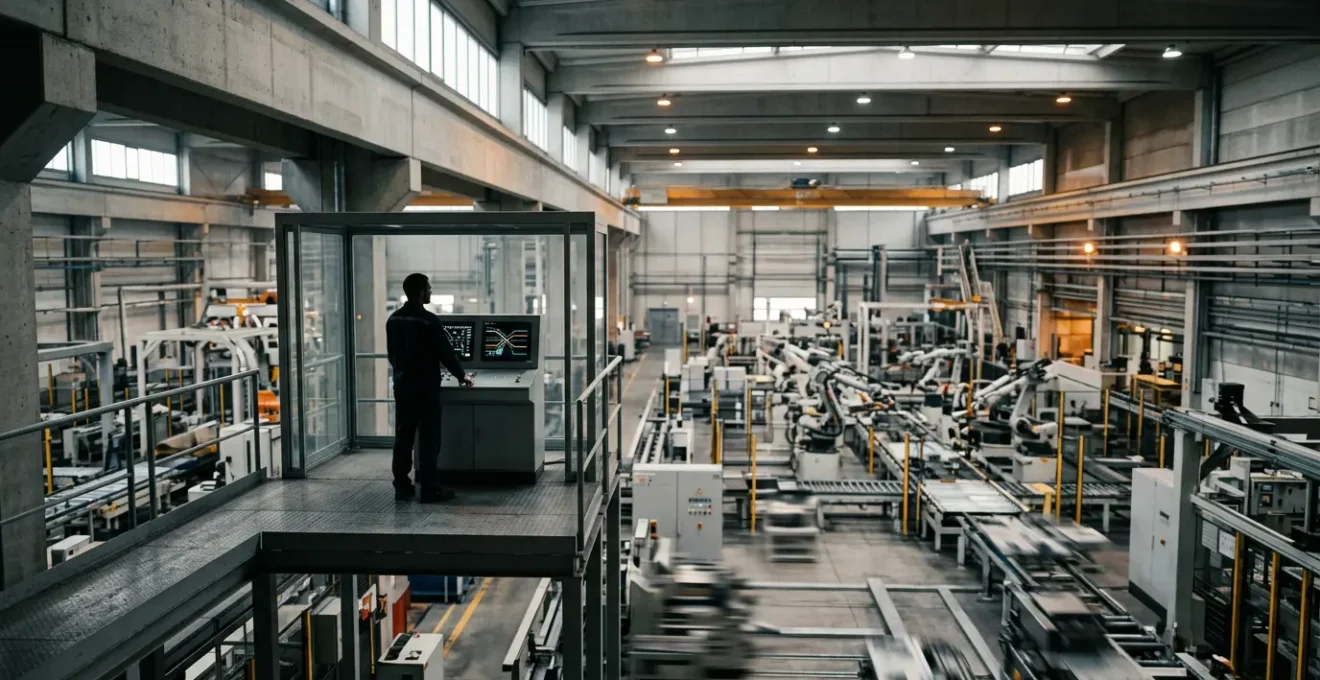
The fear that automation will eliminate factory jobs is based on a misunderstanding: the role is not disappearing, but evolving from physical labor to strategic tech oversight.
- Experienced operators are becoming ‘system managers’ who use their deep knowledge to interpret data and guide technology.
- Upskilling in areas like data analysis and predictive maintenance offers significant job security and higher earning potential.
Recommendation: Instead of fearing replacement, focus on learning to translate your hands-on experience into the language of digital interfaces and system monitoring.
For any experienced machine operator, the rise of automated systems, robotics, and smart factories can feel like a countdown to obsolescence. The prevailing narrative suggests that technology is coming to replace human hands, rendering years of hard-earned skill and intuition irrelevant. This fear, while understandable, is rooted in a fundamental misinterpretation of the industrial revolution we are currently living through. The factory of the future doesn’t have an empty floor; it has a floor filled with operators who think differently.
The transition isn’t about replacing people with robots. It’s about shifting the operator’s primary function from direct physical manipulation to intelligent tech oversight. The industry is not looking for fewer people; it is desperately searching for a new kind of expert—one who combines the wisdom of hands-on experience with the ability to manage, interpret, and direct complex technological systems. Generic advice like “learn to code” misses the point entirely. The true value lies in becoming a translator between the physical world of the machine and the digital world of the data it produces.
But what if the key to remaining indispensable isn’t about abandoning your current knowledge, but about learning how to apply it in a new context? This article breaks down this critical shift. We will explore why automation requires smarter operators, how veterans can transition from levers to tablets, and what specific skills—from predictive maintenance to data interpretation—will define the next generation of industrial tradespeople. This is a guide to not just surviving automation, but thriving in an environment that values your expertise more than ever.
To navigate this new landscape, it’s essential to understand the specific changes happening on the factory floor and the skills that are now in high demand. The following sections provide a roadmap for operators at any stage of their career, from understanding the new safety risks to building a strategy for continuous learning.
Summary: Evolving Your Role from Machine Operator to System Manager
- Why Automation Is Not Removing Operators, But Requiring Smarter Ones
- How to Transition From Levers to Tablets: A Guide for Veteran Operators
- The Safety Complacency Risk: Why Experienced Operators Cause More Accidents?
- When to Retrain: Why Manual Machinists Must Learn CNC Before It’s Too Late
- How to Master Preventive Maintenance Skills to Become Indispensable on the Floor?
- Why White-Collar Jobs Are Now More at Risk of AI Displacement Than Manual Labor
- How to Build a “Bench” of On-Demand Talent for Seasonal Spikes?
- Why Relying on Static Knowledge Is the Fastest Way to Become Irrelevant?
Why Automation Is Not Removing Operators, But Requiring Smarter Ones
The most significant shift in modern manufacturing is not the removal of humans, but the redefinition of their value. Automation excels at repetitive, predictable tasks, but it lacks the contextual understanding and problem-solving ability of an experienced operator. The result is a growing skills gap, not a job shortage. In fact, a recent Deloitte survey revealed that 48% of manufacturers face significant challenges filling critical production and operations management roles. The jobs are there, but they demand a new blend of skills.
The modern operator is a system manager. Their role is to oversee a network of automated equipment, interpret the data flowing from it, and make strategic decisions that the system cannot. Consider the case of Rehrig Pacific, which successfully integrated modern IoT sensors with its legacy equipment. Operators there weren’t replaced; they were empowered. They now use their deep, hands-on knowledge to translate real-time sensor data into actionable insights, diagnosing issues and optimizing performance in ways a pure software engineer never could. Their value is no longer in pulling the lever, but in knowing *why* and *when* the digital system needs to pull it.
This new paradigm requires a focus on developing “translational skills.” This is the ability to connect what you see and hear on the factory floor—a change in vibration, a new sound, the texture of a finished part—with the abstract data presented on a screen. This is where veteran experience becomes a superpower, not a liability. You are the essential human-in-the-loop, providing the judgment, intuition, and complex problem-solving that no algorithm can yet replicate.
How to Transition From Levers to Tablets: A Guide for Veteran Operators
For an operator whose muscle memory is tuned to physical levers and dials, the move to a glass screen can be intimidating. However, this transition is less about forgetting old skills and more about applying them through a new medium. The “feel” for the machine doesn’t vanish; it evolves into a form of digital intuition. The goal is to learn how the taps and swipes on a tablet translate into the mechanical actions you know so well. The most successful transitions treat new technology not as a replacement for experience, but as an extension of it.
This shift from mechanical controls to a digital interface is a defining moment for the modern operator, where years of experience are channeled into a new form of control and oversight.
As you can see, the core asset remains the operator’s hands-on expertise. Many companies that successfully manage this change find that veteran operators quickly become the most effective users of new systems because they understand the underlying processes. As T.J. Tatum, Senior Design Engineer at Bosch Rexroth, noted about companies embracing digital transformation, the common sentiment from the floor is often relief and empowerment. He states:
We should have done that a long time ago.
– T.J. Tatum, Senior Design Engineer, Bosch Rexroth
To make this transition smoother, a structured approach is key. The journey from apprentice to journey worker is no longer just about mastering the machine, but also about mastering the systems that control it. The following steps provide a practical framework for any operator looking to bridge the gap between manual and digital operations.
Your Action Plan: Practical Steps for a Smooth Digital Transition
- Start with Simulators: Use sophisticated simulator training to familiarize yourself with the equipment’s digital interface in a safe, virtual environment before touching the real machine.
- Demand Technical Instruction: Complete formal training on specific operating procedures and, crucially, on how to read and interpret digital plans and data readouts.
- Leverage Apprenticeships: Learn to maintain equipment and use integrated GPS or IoT devices through hands-on, guided apprenticeships with a mentor.
- Transition Gradually: Move from guided tasks under supervision to fully independent operation as a journey worker, building confidence with each step.
- Expand Your Credentials: If applicable, obtain necessary licensing like a CDL to increase your flexibility and value across different sites and machine types.
The Safety Complacency Risk: Why Experienced Operators Cause More Accidents?
It sounds counter-intuitive: shouldn’t the most experienced operators be the safest? In a traditional manual environment, this is often true. Experience builds an almost unconscious awareness of physical risks. However, in a smart factory, this very experience can create a new, insidious vulnerability: safety complacency. When an operator becomes highly comfortable with a system, they may begin to over-trust the automation, pay less attention to data readouts, or take shortcuts based on “the way it’s always been done.”
This new category of human error is a major focus of modern safety protocols. It’s no longer just about avoiding physical hazards, but also about preventing data misinterpretation or overlooking a critical alert on a busy screen. The industry is responding, with a recent analysis of industrial robotics patents revealing that human-robot safety is a major area of R&D focus, second only to AI motion planning. Modern safety training, such as the evolving OSHA compliance standards for crane operators, now requires passing both a practical demonstration and a written competency test. This is designed specifically to address new forms of error, like misinterpreting load data from a digital sensor, that didn’t exist with older equipment.
The risk lies in the gap between an operator’s deep-seated mechanical knowledge and their newer, less-ingrained digital literacy. An operator might feel a slight vibration that signals a problem but dismiss it because the dashboard shows all systems are “green.” This is where complacency turns into a real hazard. The solution is not to distrust one’s experience, but to actively cultivate a mindset of “trust but verify,” where hands-on intuition is used to question and validate the data, not ignore it. The smartest operators are those who remain healthily skeptical of their automated systems.
When to Retrain: Why Manual Machinists Must Learn CNC Before It’s Too Late
For a traditional machinist, the moment to retrain is not when your job is threatened, but when the opportunity to advance appears. The transition from manual milling and lathe work to Computer Numerical Control (CNC) programming and operation is perhaps the clearest example of the shift from manual labor to tech oversight. Waiting until manual roles are phased out is a defensive strategy; proactively learning CNC is an offensive career move that opens doors to higher pay, greater job security, and more engaging work. The urgency is underscored by stark industry projections that show 2.1 million manufacturing jobs could go unfilled by 2030 due to a lack of skilled workers.
The financial incentive for upskilling is undeniable. A machinist with deep knowledge of materials and mechanics who can also program and operate a CNC machine is exponentially more valuable than one who can only do one or the other. This value is directly reflected in earning potential, as the skills required directly correlate with higher compensation.
| Skill Level | Annual Salary Range | Key Requirements |
|---|---|---|
| Entry-Level Traditional | $35,623 – $44,864 | Basic machine operation |
| Experienced Traditional | $47,553 – $60,998 | Multiple machine types |
| Digital-Skilled Operator | $55,000+ median | IoT and data analysis |
| Specialized Tech Operator | $80,000+ | Autonomous systems expertise |
As the table demonstrates, mastering digital skills is not just about job security; it’s a direct path to significant financial growth. Calculating the return on investment (ROI) for training becomes simple. Compare the cost of a CNC certification course against the potential salary jump and the increased number of available positions. The decision to retrain becomes less of a cost and more of a high-yield investment in your own career. The best time to learn CNC was five years ago. The second-best time is now.
How to Master Preventive Maintenance Skills to Become Indispensable on the Floor?
In an automated factory, the single most valuable human on the floor is often the one who can keep the automation running. As machinery becomes more complex and interconnected, the cost of downtime skyrockets. This elevates the role of maintenance from a secondary task to a primary strategic function. An operator who can not only run a machine but also anticipate its failures is an indispensable asset. This is the shift from simple operation to mastering preventive and predictive maintenance.
This requires a new way of seeing the machinery, analyzing streams of data to find patterns that predict future problems. It’s a role that combines an engineer’s analytical mind with a mechanic’s hands-on pragmatism.
Mastering this skill involves moving beyond a fixed schedule of preventive checks. The future is predictive maintenance, which uses real-time data from sensors to forecast failures before they happen. This is made possible by a combination of edge devices—small computers near the equipment that process data instantly—and cloud computing for heavy-duty analysis. An operator skilled in this area learns to interpret the subtle language of the machine’s data logs, combining on-the-ground observation with historical performance to perform root cause analysis. You become the machine’s doctor, not just its driver.
Your Checklist: Building Predictive Maintenance Expertise
- Master Versatile Machines: Focus on programming and operating multi-functional machines like CNC and 3D printers that are controlled digitally.
- Learn to See Patterns: Train yourself to identify subtle patterns in equipment performance data, looking for deviations that might indicate a future failure.
- Document and Communicate: Keep detailed logs of your maintenance insights and share them with engineers to help them improve future machine designs.
- Combine Data with Observation: Use your hands-on experience to validate or question data logs, performing root cause analysis that combines digital evidence with physical inspection.
- Leverage AI Alerts: Develop skills in using AI-driven monitoring systems, treating automated alerts not as a command, but as a starting point for your investigation.
Why White-Collar Jobs Are Now More at Risk of AI Displacement Than Manual Labor
For years, the narrative has been that manual labor is the most vulnerable to automation. However, a fascinating reversal is underway. While robots have been replacing routine physical tasks for decades, the latest wave of generative AI is proving far more effective at automating routine *cognitive* tasks. This puts many white-collar jobs—data entry, basic analysis, report generation, and even some forms of coding—at a higher risk of displacement than skilled trades.
The reason is simple: it is currently easier for AI to write a marketing email than it is for a robot to navigate the unpredictable, complex physical environment of a construction site or a dynamic factory floor. Since 2000, 1.7 million manufacturing jobs have been lost to automation, but this has primarily targeted the most repetitive tasks. The roles that remain, such as operating heavy machinery or diagnosing a complex mechanical failure, still require a level of physical adaptability and problem-solving that AI cannot replicate. Even in a field like trucking, autonomous features will still require a human operator for the foreseeable future to handle exceptions, emergencies, and complex urban environments.
This reality challenges the conventional wisdom about job security. While it’s true that jobs requiring higher education generally face lower automation risk, this varies dramatically by field. A trade that involves complex, non-repetitive physical work is proving more resilient than a desk job centered around manipulating information. This perspective is reinforced by the World Economic Forum, which offered an optimistic outlook on this transition in its “Future of Jobs Report.”
As many as 97 million new roles may emerge as a result of adopting automation.
– World Economic Forum, Future of Jobs Report
The key takeaway is that the irreplaceability of a job is less about “manual vs. cognitive” and more about “routine vs. non-routine.” A skilled operator who can troubleshoot an unfamiliar problem in a dynamic environment is performing a highly non-routine task, making them a critical asset in the age of AI.
How to Build a “Bench” of On-Demand Talent for Seasonal Spikes?
For a business, the challenge of automation isn’t just about day-to-day operations; it’s also about managing fluctuations in demand. In the past, seasonal spikes meant hiring a large number of temporary manual laborers. Today, a smarter strategy involves building a “bench” of cross-trained, digitally-savvy operators who can be deployed flexibly. This approach provides far more agility and shields production from the high turnover associated with low-skill temporary work.
The core of this strategy is investing in internal mobility. By automating the most repetitive manual tasks, companies can free up employees to transition into more skilled operator and programmer roles. This creates a versatile internal talent pool. A key enabler for this strategy is the use of modern training platforms. Companies using centralized platforms for design, automation, and operation find that they can achieve automation 3x faster, which includes the rapid upskilling of their workforce.
A robust talent bench is built on several pillars. First is the development of in-house certification programs for specific digital systems and machinery simulators. This standardizes skills and makes it easy to know who is qualified for what task. Second is the use of modular training that can be deployed quickly. Finally, cutting-edge companies are implementing Augmented Reality (AR) for onboarding temporary operators. An AR headset can overlay instructions and diagrams directly onto the equipment, dramatically reducing training time and error rates for new or temporary staff. This allows a company to bring in talent for a seasonal spike and have them be productive almost immediately, without a long, costly training period.
Key Takeaways
- Your value is shifting from physical execution to cognitive oversight and problem-solving.
- Hands-on experience is not obsolete; it’s the critical context needed to interpret digital data effectively.
- Continuous learning is no longer optional; it’s the core requirement for job security and career growth.
Why Relying on Static Knowledge Is the Fastest Way to Become Irrelevant?
In the industrial era, a machinist could learn a trade and rely on that knowledge for decades. In the smart manufacturing era, that same knowledge base might become outdated in just a few years. The single greatest risk to an operator’s career today is not automation itself, but the belief that their current skill set is sufficient for the future. Static knowledge is the fastest path to irrelevance. The pace of technological change is accelerating, and the frequency of required knowledge updates has compressed dramatically.
The imperative is to shift from a mindset of “I am trained” to one of “I am always training.” The skills that are valuable today—like interpreting sensor data or collaborating with an AI system—did not exist a decade ago. The skills that will be essential in five years are likely just emerging now. This requires a commitment to lifelong learning, not as a periodic event, but as an ongoing part of the job itself. Embracing this dynamic reality is the only way to stay ahead of the curve.
This table illustrates how the required frequency of skill updates has accelerated, moving from a decade-long cycle to a continuous, monthly process.
| Era | Primary Skills | Knowledge Update Frequency |
|---|---|---|
| Manual Era (Pre-2000) | Physical operation, mechanical knowledge | 5-10 years |
| Digital Transition (2000-2020) | Basic computer skills, PLC programming | 2-3 years |
| Smart Manufacturing (2020-2025) | Data analysis, IoT integration | 6-12 months |
| AI-Driven Future (2025+) | AI collaboration, predictive analytics | Continuous/Monthly |
The future belongs to the adaptable. The operators who will thrive are those who are curious, embrace change, and actively seek out new knowledge. This doesn’t mean you need to become a software engineer, but it does mean you need to understand the systems you work with, ask questions about how they can be improved, and be willing to learn the new interface or tool that comes out next year. Your long-term security depends not on what you know today, but on your willingness to learn tomorrow.
The journey from manual operator to system manager is a profound shift, but it is one that empowers rather than replaces. By embracing continuous learning and leveraging your invaluable hands-on experience as a lens through which to view new technology, you position yourself not as a victim of automation, but as its essential human partner. Start today by identifying one new digital skill relevant to your work and find a resource to begin learning it.